 2 minute read
Laser Scanning for Floor Flatness: Practical Implementation in Construction
Structured Floor Flatness Verification Using the RIEGL VZ-600i
Ensuring floor flatness is a critical requirement in many construction projects. Reliable verification methods are essential not only for compliance, but also for ensuring long-term functional performance.
A technical study originally published in Vermessung & Geoinformation (Austria) and later featured by RIEGL demonstrates how terrestrial laser scanning can be applied as a method for checking the flatness of construction site floors.
Rather than focusing on theoretical capability, the study presents a real project example.
Project Overview: 450 m² Floor Area
The practical application was demonstrated on a newly constructed floor area measuring approximately 450 m².
The entire area was captured in a short period of time using multiple scan positions, notably while construction activities were still ongoing. This shows that laser-based capture can be integrated into active site environments without requiring full work stoppage.
For data acquisition, the RIEGL VZ-600i terrestrial laser scanner was used to collect high-density 3D measurement data across the full surface.
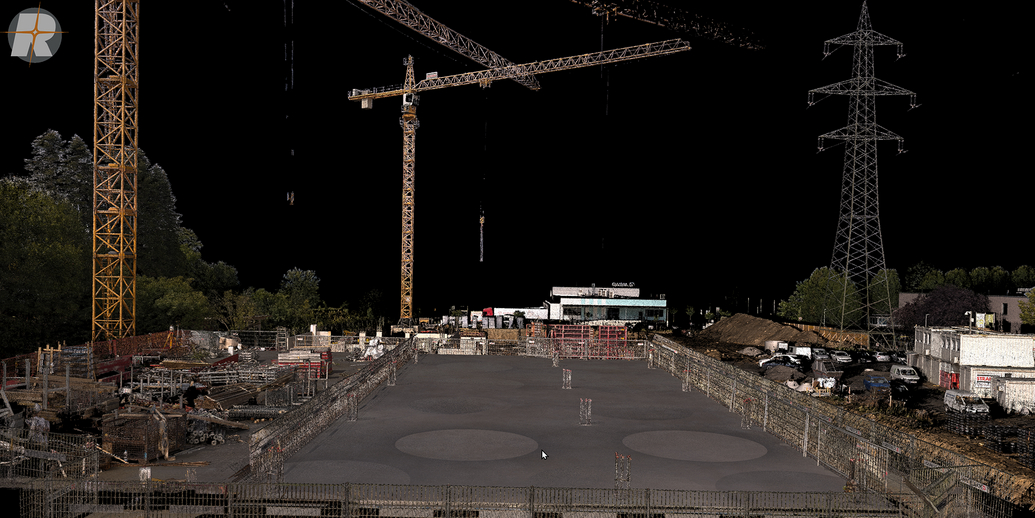
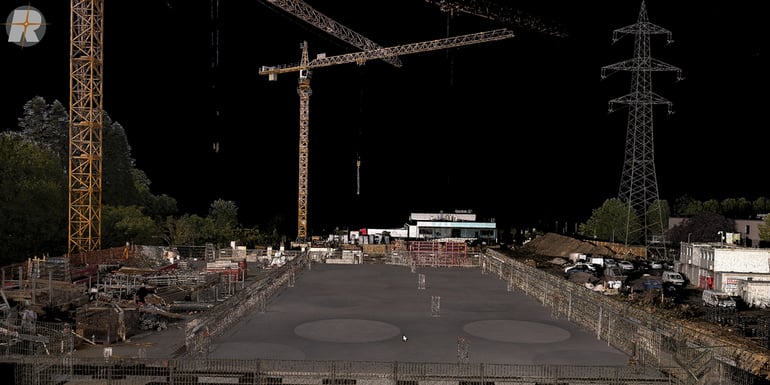
The image above shows a point cloud generated from 17 panorama 6 mm scans, captured using a RIEGL VZ-600i laser scanner.
How the Evaluation Was Performed
Following acquisition, the individual scan positions were registered and adjusted using RiSCAN PRO software.
Once aligned, the resulting point cloud formed the basis for further analytical evaluation.
Elevation points were determined across the floor area using a regular 50 cm grid. This structured grid approach enabled consistent evaluation across the entire measured surface.
To improve reliability, neighbouring grid points were averaged. This step reduced measurement noise and increased the accuracy of elevation determination.
Flatness Evaluation in Practice
The significance of the 450 m² example lies not only in the data capture, but in how the data was structured for evaluation.
By extracting elevation values on a defined 50 cm grid and applying local averaging, the workflow translates a dense point cloud into a format suitable for flatness analysis.
This structured processing step bridges the gap between raw laser measurements and usable verification results - allowing consistent evaluation across the entire floor area, even within active construction environments.
Source Reference
This article is based on:
“Laser Scanning as a Method for Checking the Flatness of Construction Site Floors,” originally published in Vermessung & Geoinformation (Austria) and featured on the RIEGL Australia website.
For the complete technical article, please refer to the RIEGL website.
If you would like to explore how terrestrial laser scanning can support your construction planning workflows, our team is available to discuss practical implementation strategies and live demonstrations tailored to your operational requirements.

 3 minute read